Showing posts with label patternmaking. Show all posts

Monday, 21 November 2011

Enlightening

Dear readers! Last week I had an enlightening moment. One than initially filled me with dread, shock and horror but have come to accept. I have discovered I am a procrastinator! I am, indeed, a total utter procrastinator! The first reaction of shock and horror was due to my assumption that procrastinators are horrible people who are lazy and don't bother or care about doing things. And that is simple not me. I am not lazy and I do care about things.

As you might already know, I am taking a short course on Pattern Making at the London College of Fashion. I'll be finishing off in two weeks and already a bit sad to see the end of it. I am loving it so, so much and there is so much more to be learned (I would probably give an arm and a leg to be able to do a full time course). My main motivation to do this course is the zillion ideas for designs in my head that I simply cannot put on paper. I am terrible at drawing, even though I am trying!
I want to be able to design my own clothes but I would also love to share these designs with other people. How exactly, I do not know yet but I have a few possible ideas kicking about in my head.

And this is how I realised I am a procrastinator!! I have ideas, I somewhat know what I want to do but I fail to do it. I know what little steps (some, at least) I need to take to reach my goal but I end up doing other stuff. I delay, delay, delay and then get frustrated because I haven't done what I want.

Google is my friend and I found out a bit more about procrastinators that I have identified with myself (and that made me accept the fact a bit better):

  • Procrastinators get overwhelmed when the task ahead is too big. Well, that's me! When there's so many things to do and so many things to find out and things that I don't know about, things to consider....ahhhh! I am like this at work actually and thought it was because I didn't love the task ahead but it's not. It's the complexity and enormity of the task.
  • Procrastinators can be so because they are perfectionists. We'll, that's me too! I want to make sure everything is just right and all the conditions met. I know in real life this is not possible and mistakes and errors are the best way of learning, but I want to have it as good as I can. This happens in my day job too. I usually tweak an action plan for ages until someone asks me when am I going to implement it.
  • Finally, and this is the crunch one with my current objective. I am so afraid of being a utter failure and not being able to hack it. And actually on my day job I don't have this problem mostly because it's not just my project (I might lead but there are hundreds of active partners whom success depends on too).
So what are your thoughts on this? Are you a procrastinator? Do you have any tips in how to deal with it? As always, I would love to read your thoughts. (and honestly, if you know of any great self help book to deal with it, I am that desperate ;)

Photos taken with phone and compact camera using Instagram or edited in Picnik.
Monday, 30 May 2011

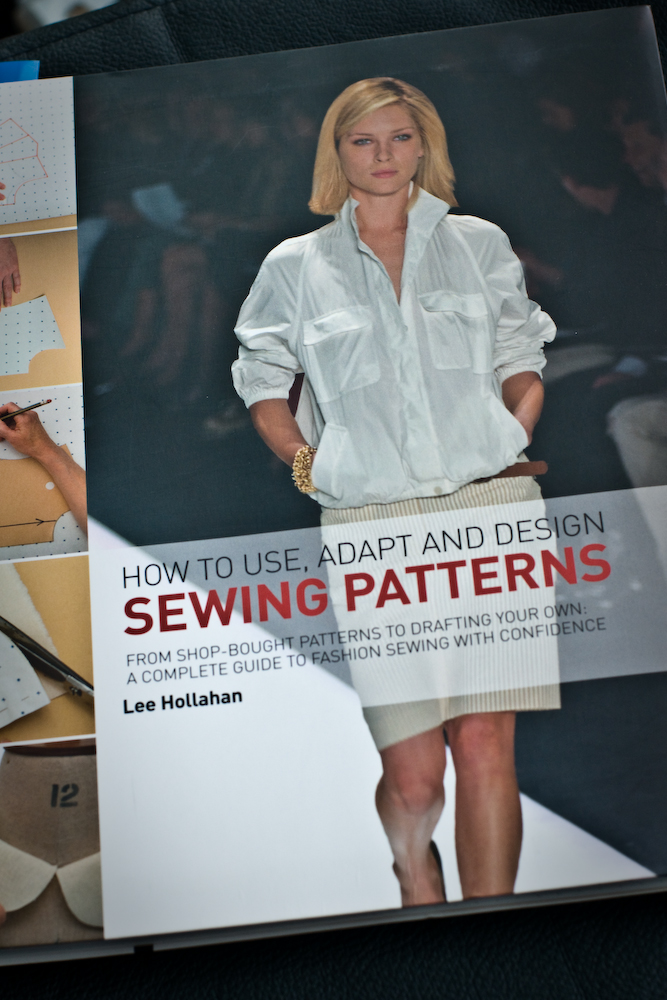
May Book Analysis - "How to Use, Adapt and Design Sewing Patterns" by Lee Hollahan

This month I dwelled deep into one of the first books I bought. "How to Use, Adapt and Design Sewing Patterns" by Lee Hollahan promises to show us "how to get the most from sewing patterns - from choosing the right size to understanding all the different markings and translating flat shapes into wearable garments. You will learn how to change the shaping, length and detailing to suit your own body shape, taste and style."
I think it delivers this, but only at a beginners level. A more experienced seamstress or pattern maker will probably find this book quite basic. That's why I bought it! I was quite a beginner and not yet had a full understanding on many simple basic things. Understanding what notches are and why they are important alongside other markings on commercial patterns helped me a lot on my initial journey.

Chapter 1 is all about tools and equipments (as you so often find in beginners books). All your necessary tools are listed alongside others not fundamental but quite handy, such as pattern master or french curves. Whilst I read on many blogs that you can just use a plate or any round objects to tweak curves in patterns, if you're serious about pattern making these come in very handy.
Chapter 2 is all about commercial patterns. This section was so helpful in deciphering those pattern envelopes, which did puzzle me when I first saw them. Illustrations of commercial patterns, both enveloped and tissue pattern itself, with description of what each marking or text there means, makes it very, very easy to understand.
One of my favourite sections in this chapter is about body shape. I always knew pencil skirts are not the most flattering for me, but I love them and always try using them and styling them. Reading that it is because I have a narrow rectangle body shape helps me accept it and move on.
I am indeed a narrow rectangle but I am not tall. I am quite petite in fact.
This chapter guides you in taking accurate measurements and also help understand what wearing ease and design ease is all about. Tips on cutting and marking fabric are also included. All with brilliant illustrations that take the guess work out of it. I can't stress enough how important I think illustrations are for beginners.

Chapter 3 introduces us to pattern alterations. No major creative pattern alterations though, just the basic ones such as shortening and lengthening pieces, moving bust point, moving darts, increasing or decreasing a waist band. A big disappointment is the lack of trousers alterations, apart from length.
Chapter 4 progress to designing own patterns. It explains what pattern blocks are and how you can use them. This book also offers pattern blocks at the end that can be transferred to grid paper and used as a baseline for your creations. No trousers though. It guides us to making our own toile or muslin and altering it to create a perfect fit. In this chapter there are some more advanced pattern alterations such as those relating to armholes and (yay!) trousers, including crotch and leg length.
The idea is that after you have perfected your toile/ muslin you transfer all alterations to your blocks and from these you can start the creative work. A dressform is presented as fundamental for this work, as a lot of the pattern design lines are tried and tested on a dressform.
The book progresses with some pattern manipulation ideas for sleeves, skirts, collars, etc., all wonderfully illustrated and explained. It's fascinating to read how a simple dart alteration can significantly change the whole design of a garment.
Chapter 5 contains the pattern blocks already mentioned and Chapter 6 presents core sewing techniques. I confess I never look at this last chapter as I have a couple of sewing technique books.
I did start work on my own pattern block last year but have not yet progressed any further. I will resume this soon as I do want to dwell further onto pattern making.
My head is full of wonderful designs which I fail to draw successfully so mastering pattern making might be the key to bring this designs into life. Watch this space! ;)

Do you have this book or other pattern marking books? How much do you alter or indeed create your own patterns?

P.S. I apologise for not having this post up yesterday. The fact it's a bank holiday weekend made me feel it was just Saturday yesterday.

LinkWithin

Related Posts Plugin for WordPress, Blogger...